Wednesday, February 20, 2019

Week Seven Prompt


"... talk about a time when a book or author that made headlines affected you personally or your work" (Cataldi).


Bill Cosby: Comedian, educator, 
convicted felon.

In the past 7+ years of working in the children's departments of public libraries, I  have not been asked for items related to Mr. Cosby. By the time the revelations about his behavior came out, he was on the waning side of his career, but held in high esteem for his contributions to children's education and American comedy. 

Almost daily I come across Cosby DVDs or beginning readers that used to bring back fun memories only to look at them now with repulsion. The children who see his books today may not associate them with a TV series or "America's Dad," but their parents have probably seen the headlines revealing his history of sexual assaults.  I looked up library materials under the author heading "Cosby, Bill." Our catalog showed an inventory of 21 items. Only one of those items was currently checked out. It was a beginning reader ironically entitled, My Big Lie, from the series, Little Bill Books for Beginning Readers. I would need to access and study library statistics to discover if circulation of his materials changed after the scandal broke and/or after he was indicted and convicted. 

Name recognition in politics, sports, and the arts can influence votes or attendance, and attract avid fans or detractors. Oprah's Book Club recommendations drove sales of lesser known authors to best seller status (Butler). When I attended the 2017 ALA Annual Conference, Sarah Jessica Parker and Hillary Rodham Clinton filled auditoriums for their talks (Liao). Would Bill Cosby's children's books be in publication if he wasn't a celebrity? Would they be on library bookshelves if he were a convicted child molester?  Can the merit of his books and shows be considered separately from his character? 

Inclusion or exclusion of materials requires consideration of a library's collection development and management policies. I wonder how many librarians have removed materials authored by Bill Cosby because of his conviction, or if those materials have been weeded because more popular books and shows required the shelf space. Banning items that are worthy of inclusion, although the collector may feel the author is not, is a dangerous precedent to make. 


Notes

Butler, R., Cowan, B., & Nilsson, S. (2005). From obscurity to bestseller: examining the impact of Oprah's Book Club selections. Publishing Research Quarterly, 20(4), 23-34. Retrieved from Academic Search Premier database.

Cataldi, E. (2019). Week Seven Prompt. Readers' Advisory. Retrieved from http://readersadvisoryblog.blogspot.com/

Liao, Angela. (2017) Celebrity book clubs create virtual reading community. Bookstr. Retrieved from https://www.bookstr.com/celebrity-book-clubs-create-virtual-reading-community

Monday, February 18, 2019

Annotation: Mystery Genre


Title: A Curious Beginning

Author: Deanna Raybourn
Genre: Mystery 
Number of Pages: 337
Geographical Setting: England
Time Period: Victorian, 1887
Series: Veronica Speedwell (Book One)

Plot Summary:
Orphaned as an infant, Veronica Speedwell loses her last tie to England when Aunt Nell dies. Her passion for lepidoptery has taken her around the world and led to other discoveries. "It was not until my first butterflying expedition at the age of eighteen - a month-long sojourn in Switzerland - that I discovered men could be just as appealing as moths" (Raybourn 9). Now truly alone, the pragmatic and confidently unconventional Veronica packs her butterfly net and small travel bag for an expedition to the tropics. Her plans are waylaid when she is abducted from her village cottage. A mysterious German baron suddenly materializes to save her, then insists that she is in mortal danger and must come away with him. He assures her that he knew her mother and that he will share more details when they reach London. Curious more than convinced, and happy not to have to pay her way to London, Veronica accepts. She soon finds herself deposited with the baron's friend, Stoker, a disheveled, rude, but oddly appealing naturalist with secrets of his own. When the baron is killed before he can tell Veronica the long-hidden truth about her past, Veronica and Stoker find themselves on the run from authorities and persistent villains. The two must unravel the tangle of clues if they are to outwit the killer and uncover the secrets that threaten their lives.

Subject Headings: Orphans, Women Sleuths, 19th century England

Characteristics of the Mystery/Amateur Detective Genre
(Saricks 198, 214)

Story Line: Veronica and Stoker are brought together in order to solve the baron's murder and its connection to Veronica's past.

Characterization: The story focuses on Veronica, the first person narrator/protagonist, but Stoker is also a prominent and complex figure integral to the plot.

Frame/Setting: The story takes place in 1887, the year of Queen Victoria's Golden Jubilee. Vivid descriptions of taxidermy and  natural history collections create an unusual but compelling context for the mystery.

Tone/Mood: The protagonist's playful, often mischievous, behavior contributes a lighter tone to occasionally gritty situations.

Style/Language: Veronica narrates the story. Her observations are insightful and and evocative. Scientific terminology related to the natural history profession is used throughout and serves to inform and to engage readers. The verbal sparring and expressive language keep the plot moving and make the characters appealing and relatable. In one instance, Stoker is wearing a suit as it is being altered. The many pins in the jacket are poking him, and he is complaining about the pain."Help me out of this coat," he ordered. "I feel as if I were in the grip of a lethargic anaconda" (Raybourn 106).

Pacing: The dialogue between Veronica and Stoker maintains the quick pace when the action slows. Suspense about Veronica and Stoker's relationship builds with the suspense surrounding the crime.


3 terms that best describe this book: 
Engrossing, entertaining, informative.


Read Alikes 
(Source: NoveList, https://www.carmel.lib.in.us/)


Kasasian, M. R. C. (2015). The Mangle Street murders. New York, NY: Pegasus.
Reason: While Curious Beginning takes place largely among Victorian London's upper classes and Mangle Street Murders explores its dark alleys, both novels feature young, intelligent women teamed with disagreeable male detectives on murder investigations. Witty dialogue drives these complex, immersive plots. -- Jen Baker


Alexander, T. (2009). And only to deceive. New York, NY: Harper Collins.
Reason: These books are Suspenseful and Richly detailed, and they share: the genre "historical mysteries"; and the subjects "independence in women" and "young women."


Thomas, S. (2016). A study in scarlet women. London, UK: Berkley.
Reason: These authors' works are Suspenseful and Richly detailed, and they share: the genres "historical romances" and "historical mysteries"; and the subject "men/women relations."
                                                                                                                                                                                    

Notes

Raybourn, D. (2015). A curious beginning: A Veronica Speedwell mystery. New York, NY: New American Library.

Saricks, J. G. (2009). The readers’ advisory guide to genre fiction. Chicago: ALA.

Thursday, February 14, 2019

Week Six Prompt - Romance


Every book its reader -
S.R. Ranganthan

Will You Be Mine?

Adult Display example
(Source: Pinterest, book wrapper)


Every book its reader - S. R. Ranganthan
Will You Be Mine? 
Children's Display Heading
 (Source: https://www.whooosreading.org/)


Will You Be Mine?
Young Adult Display
 (Source: Pinterest, https://www.pinterest.com/kathleencarbert/library-bulletin/?lp=true


Will You Be Mine?
AV Movie Night: The Princess Bride
Image Source: The Princess Bride (1987)


This library-wide promotion will run February 1 - February 14.

Following Saricks’ suggestions, each department can choose to include titles from "biographies about romantic historical figures, memoirs detailing successful relationships, and subjects dealing with the creation of families"(Saricks 149). Bookmarks with suggested Romance ebooks can also be part of the adult displays.

Various media will be displayed to appeal to the moods and interests of patrons. "When determining the media experience the patron is looking for, it is important to consider how the patron wants to interact with the media and respond accordingly" (Dunneback 186). This promotional campaign will showcase the many formats available to patrons
who are current fans of Romance and to patrons new to the genre.


Adult and Young Adult (2nd floor)
There will be a simple table craft for young adults and adults. It will have die cut paper hearts, and some decorative pieces, markers, and glue sticks that patrons can use to make their own valentines.

Young Adult & Adult craft idea 
(Source: Pinterest, valentine craft


Some items will be wrapped which will add to the fun and may encourage reluctant readers/viewers of Romance to check out those materials. Staff will write the three three subject terms they feel best represent the title on the wrapper. The theme is based on S.R. Ranganthan’s third law of library science, Every book its reader. (Ranganthan)

"Every book its reader - Will You Be Mine?” These words will be written on display headers. Paper hearts on each wrapper will say "Be Mine." Readers Advisory and Adult Reference staff will wrap titles from Adult Fiction, Mystery, Biography, and relevant Non-Fiction. Young Adult staff will wrap YA materials.


Audiovisual (AV) (1st floor)
The AV department will wrap Romance audiobooks and films. The AV department will run a classic romance movie on its usual monthly movie night. One possibility would be "The Princess Bride." William Goldman wrote the 1973 book and the movie's screenplay. A display of relevant titles will be available to audience members. Bookmarks suggesting potential movies, ebooks, and audiobooks will be part of the display.


Adult Reference and Readers Advisory will work with the Audiovisual (AV) department to coordinate departmental displays and marketing materials that match the theme. Young Adult and Children's will submit their own requests for materials tailored to their age groups. All departments will share the same theme. Submissions for the library website, newsletter, and in-house posters will be made two months prior to the start of the program which will run the first two weeks of February.

Children (1st floor)
The children's department can join the promotion to ensure that younger patrons are included in the fun.  A drop-in craft or table craft similar to the one for adults will be set up in the department.

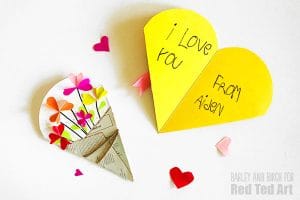
collage-heart-cards-for-toddlers-valentine-5
Children's craft idea (Source: Pinterest, https://www.redtedart.com/14-valentines-cards-for-kids/

The same “Will You Be Mine?” theme can apply. Staff will wrap children’s books, audiobooks, and movies. Other types of love (such as family, friends, and pets) and the diversity represented within those categories will fill the display. All of the children's display materials will be wrapped. 

Individual display for Adult and Audiovisual departments
There have also been different versions of movies based on books that could be used for an integrated display in the Adult department. One example is Jane Austen's Pride and Prejudice. Not only have there been several movie versions and at least one miniseries, there have also been movies, miniseries, and books that take Austen's characters and put them in different situations. The 2013 BBC miniseries, Death Comes to Pemberly, was based on P.D. James' mystery of the same name. Seth Grahame-Smith's 2009 parody novel, Pride and Prejudice and Zombies, was later made into the 2016 film of the same name. The display could be called "Love Elizabeth and Darcy, but want something new? Try these takes on Jane Austen's Pride and Prejudice":


References

Austen, J. & Grahame-Smith, S. (2009). Pride and prejudice and zombies. Philadelphia, PA: Quirk.  

Dunneback, K., & Towner, M.W. (2010). Everything romance. In Moyer, J.E. (Ed.), Integrated advisory service: Breaking through the book boundary to better serve library users  (pp. 183 - 225). Santa Barbara, CA: Libraries Unlimited.


Goldman, W. (1973). The princess bride: S. Morgenstern's classic tale of true love and high adventure. New York, NY: Harcourt Brace Jovanovich. 


James, P.D. (2011). Death comes to Pemberly. New York, NY: Knopf.

Lear, N. (Producer), & Reiner, R. (Director). (1987). The princess bride [Motion Picture]. United States: Act III Communications.

Ranganthan, S.R. (1931). Five laws of library science. London: Edward Goldston.

Saricks, J. G. (2009). The readers’ advisory guide to genre fiction. Chicago: ALA.

Sunday, February 10, 2019

Kirkus-Style Review


The Only Woman in the Room
by Marie Benedict


A teenage Austrian actress charms a wealthy weapons manufacturer and secretly designs a device to undermine the Third Reich in World War II.


Readers who enjoy historical fiction about WWII, biographies, and the golden age of Hollywood, will find much to like about this book and the fascinating woman who inspired it. Benedict crafts a fictional biography about the glamorous Hollywood actress, Hedy Lamarr, that is fast-paced and suspenseful. By the age of nineteen, Hedy Kiesler had created a scandal by appearing nude in an art film, redeemed herself to achieve acclaim in the Austrian theatre world, and married an Austrian munitions magnate with ties to Nazi Germany in order to protect her family. And that was just the beginning. The story starts in 1933 Vienna just after Adolf Hitler has become Chancellor of Nazi Germany. In this first-person narrative, young Hedy Kiesler takes the reader into her confidence as she struggles to keep herself and her family safe from the Nazi menace.  Accustomed to men underestimating her intelligence, she consciously uses her beauty as a mask. “The only onus that you should carry on your delicate shoulders is that of your beauty,” her husband Fritz tells her. That mask protects her as she listens to her husband’s conversations with Hitler and Mussolini and learns of their horrifying plans for Europe’s future. Marriage to the mercurial Fritz Mandl sharpens her survival skills until she finally devises an escape plan that will carry her to London and then to Hollywood where she becomes Hedy Lamarr. Eager to find a way to fight the Nazis, Hedy calls on memories of her husband’s business discussions to invent a device to help the Allies. If only the U.S. Navy will accept her as an inventor and not just “the only woman in the room.”


An engrossing portrait of an enigmatic actress whose scientific contributions were overshadowed by her glamorous image.

Pub. Date: Jan. 8th, 2019 Page Count: 272 pp Review Posted Online: February 10, 2019

ISBN:  978-1492666868               Publisher: Sourcebooks Landmark           Kirkus-Style Reviews Issue: March, 9, 2019


Saturday, February 9, 2019

Week 5 Prompt Response

Look over the reviews - do you feel they are both reliable? How likely would you be to buy this book for your library?


The two ebook only reviews were hard to read. Both suffered from poor grammar and a lack of punctuation that detracted from the authors’ comments and my impression of them as reliable sources. The Amazon comment came across as more authentic than the blog post.
The Amazon reviewer clearly liked the book and summarized her feelings in a brief remark next to her rating: “Beautiful, sweet, Christmas romance.”
The blogger’s review was visually appealing, but confusing. In one paragraph the reviewer states, “It’s too Christmassy…” The last paragraph begins with, “I wasn’t hooked to the core, but it’s okay.” The last few sentences of the review seemed to contradict those earlier comments:


“I felt it’s just the right choice. I started really feeling the season. Very warm and cozy and I actually enjoyed this one despite finding the plot odd.”
Another feature of the blog was the stark contrast in writing style between the summary and the review. It did not seem as though the same person had written those sections, but there was no attribution to another source. I did not find the blogger to be a reliable source and would not use them for future collection decisions.
If there is demand for this type of title I would consider buying it. The decision would also depend on selection criteria such as availability of similar titles and pricing.


How do these reviews make you feel about the possibility of adding Angela's Ashes to your collection?


The School Library Journal review glossed over McCourt’s graphic description of his wretched childhood. “He recounts his desperately poor early years, living on public assistance and losing three siblings, but manages to make the book funny and uplifting.” The review had a strange juxtaposition of comments. The reviewer says  young people will recognize “the casual cruelty adults show toward children.” That observation is immediately followed by “Readers will enjoy the humor and the music in the language.” I received the strange impression that this was a humorous children’s book with sad elements.
I disagree with the Library Journal review that recommends the book “for readers of any age.” Neither this review nor the School Library Journal review provides an excerpt or description of the memoir’s darker moments and more mature subject matter.
The Kirkus and Booklist reviews provide a clearer glimpse into the complex, evocative language that brings McCourt’s harrowing childhood to life.
“Dying was what everyone seemed to do best: the little sister, the twins, the girl with
whom Frank first had sex, the old man Frank read to, too many boys from school, too
many neighbors, too many relatives.” (Booklist)


“Forced to move in with an abusive cousin, McCourt became aware that the man and his mother were having "the excitement'' up there in their grubby loft. After taking a beating from the man, McCourt ran away to stay with an uncle and spent his teens alternating between petty crime and odd jobs.” (Kirkus)


The authoritative sources for these reviews would influence my decision to include this book in the library’s collection. If I were only reading the School Library Journal and Library Journal reviews (and did not know that Angela’s Ashes had won the Pulitzer Prize in the biography category), I might have placed the book in the children’s collection. After reading the Kirkus and Booklist reviews, I would place the book in the young adult and adult collections.


Do you think it's fair that one type of book is reviewed to death and other types of books get little to no coverage? How does this affect a library's collection?


I think it is an unfortunate reality that some book publishers have substantial marketing resources and other publishers have little or none. Publishers’ marketing efforts influence the public’s awareness of particular books. Review sources build awareness and influence perceptions of new books. The proliferation of independent publishers, self-publishing, and social networking sites has inundated collectors, reviewers, and the public with new titles. Collection selection does not have to be based entirely on reviews, but time constraints mean that librarians often rely on reviews to inform collection decisions.
In response to the growth of new formats and genres, our library’s collection development has become more specialized. Individual librarians are responsible for particular collections and/or collection sections (such as picture books or the 400s section of non-fiction). This allows collectors to discover review sources they trust, and to learn about upcoming releases from a wider range of publishers.


And how do you feel about review sources that won't print negative content? Do you think that's appropriate? If you buy for your library, how often do you use reviews to make your decisions? If not, how do you feel about reviews for personal reading, and what are some of your favorite review sources?


If a review source does not print negative content, the reason behind their decision needs to be clearly stated.  Does the review source only review titles it likes? Does that mean they do not like other titles, or that they deem particular titles to be exemplary and deserving of a review?  Should more value be placed on those reviews because they are more selective in their choices? According to its website, Booklist has had its “recommended-only” policy since its founding in 1905. That policy
has been adapted over the decades to reflect changes in the philosophy of public library service. Thus, materials are recommended for reasons relating to both quality and demand” (Booklist).
Collectors develop review source preferences over time. When collectors change, the collection’s composition will likely change to reflect the new librarian’s perspective.
I am not a collector. When I find a book or series I like, I usually look for read-alikes. I do not seek out reviews to make personal reading choices, but I have come across books for my personal reading when I read journals at work. Some of my favorite review sources are Publishers Weekly, Kirkus, and the New York Times Book Review. I find upcoming titles in Publishers Weekly.  If I want more guidance, I read the other two sources which tend to give me a clearer insight into whether or not the author has a style and language that appeal to me.

References

Booklist. (1999). Booklist selection policy. ALA. Retrieved from
http://www.ala.org/aboutala/offices/booklist/insidebooklist/booklistpolicy/booklistselction


Annotation - Romantic Suspense


Sunday, February 3, 2019

Secret Shopper Assignment: Summary

When I arrived at the library, I noticed that there was no separate Reference Desk, so I walked up to the Information Desk.  I waited for a moment until the available librarian looked up and asked if he could help me. I replied that my 20 year-old daughter had asked me to find a romantic suspense novel for her. The only tool he used was the library catalogue. He showed me how he entered the search term “romance and suspense.” Then he asked me to look through the results to see if I liked anything. As he scrolled through the titles, he stopped to say, “Oh look, it’s a genre.” He then changed his search to focus on Romantic Suspense as a genre, and we went through the same process again. At one point he noted that the titles were very short and began to scroll through them more quickly. It was hard to read and evaluate options at that rate. Out of frustration I asked him to stop on a few titles and to write down their names. He offered to show me where the books were and I accepted. When we got to the shelves he said that if I had more questions to come and ask.


This was not the interaction I expected to have. The librarian did not ask me any of the readers' advisory questions Vnuk suggests (Vnuk). I thought he would ask if my daughter had any favorite Romantic Suspense authors, or if not, what was the last book she read that she liked. When it became apparent that he was unfamiliar with the genre, I thought he would ask another librarian for suggestions. He did not. Saricks notes that her library maintains a list of Traditional Romantic Suspense authors. It did not appear that he had a similar list. She also recommends that librarians be aware of newer popular Romantic Suspense authors and their series (Saricks). It was unclear if the librarian was from a different part of the library and was filling in at the desk or if this was his usual job. It was clear that he did not know of any Romantic Suspense authors or titles.


The experience was disappointing. Although the librarian was pleasant, he was unable to suggest any Romantic Suspense books or similar genres that might appeal to my daughter. When I tried to help him by giving him the name of one of my daughter’s favorite authors (Rhys Bowen), he did not react at all. The books on the list he gave me were Romantic Suspense, but I felt that the list could have been tailored to my needs if more questions had been asked or if he had consulted another librarian who may have been familiar with the genre. The librarian did not suggest any books, and I do not think that I would go to him in the future. My impression might have been different if he had put more effort into helping me.


References
Saricks, J. G. (2009). The readers’ advisory guide to genre fiction. Chicago: ALA.

Vnuk, Rebecca. (2013). Jack of all trades readers’ advisory: How to learn a little about a lot. Public Libraries Online. http://publiclibrariesonline.org/2013/05/jack-of-all-trades-readers-advisory-how-to-learn-a-little-about-a-lot/